Relive the Webinar: Building Inclusive Digital Communities for Sport for All
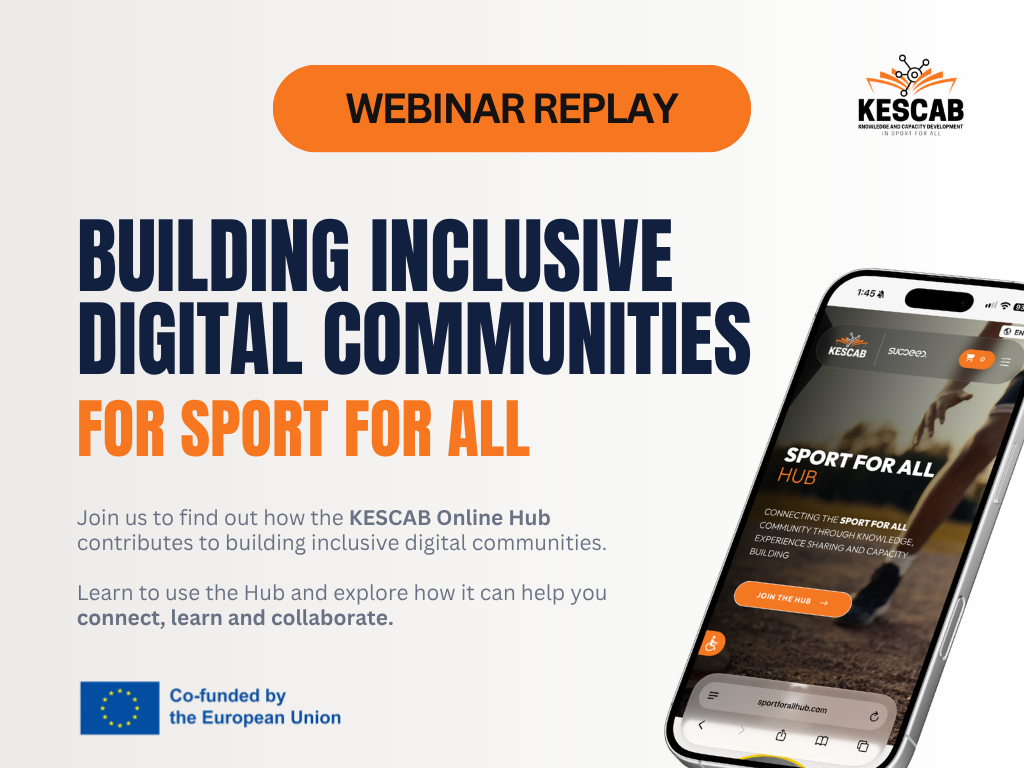
On 24 November 2026, the KESCAB project partners hosted the webinar "Building Inclusive Digital Communities for Sport for All," which also served as the Final Conference of the KESCAB Online Hub project. The session brought together enthusiasts, trainers, practitioners and organisations from across the Sport for All movement to explore how digital platforms can make capacity building an ongoing journey of learning and connection, rather than a one-time event.
From one-off workshops to lasting communities
The webinar opened with an input from Amanda Lima, Head of Programme Operations, Laureus Sport for Good, Brazil, who highlighted a common challenge: after a capacity-building workshop ends, participants are often left to put what they have learned into practice on their own. She explained that digital communities can strengthen capacity building in three ways: by sustaining relationships, sharing knowledge, and ensuring continuity, so that people can return with questions and receive feedback long after a training session is over.
According to Amanda, an effective digital community must offer genuine value, be realistic about what it can achieve, and be inclusive. Content should be relevant to its audience, with space for shared interests and groups. She also stressed that keeping a community alive is the responsibility of every member, with participants gradually moving from consumers to contributors and, eventually, to providers of knowledge on the Hub.
A live Demo of the KESCAB Online Hub was presented to participants by Gaetan Garcia, Head of Operations, TAFISA. He highlighted the hub's features, discussion groups and courses, specifying how the hub aims to serve the Global Sport for All movement. Its objectives include:
Widening access to capacity building.
Sustain capacity building beyond individual events. Provide the infrastructure through which learning continues after a course concludes.
Build and retain a professional network.
Enable peer learning and mentorship at scale. Create conditions in which experienced practitioners can support emerging leaders, and in which practice developed in one country becomes visible to practitioners in another.
Establish shared sector infrastructure. Provide a platform that partner organisations and external providers can use to deliver their own training, rather than each developing separate systems.
What makes digital communities work
In the panel discussion, Fernando Soria Hernández, Secretary General, Instituto España se Mueve, Spain, Stephen Ojo, Operations, Afroballers and Amanda Lima shared insights on building and growing digital communities. The panellists emphasised the importance of understanding what motivates community members, as this is key to growing a community and recognising the value each member brings.
They also highlighted the need for a clear engagement plan that gives users a reason to participate. Approaches such as gamification and leaderboards can help keep members engaged, while inviting experts and making training more dynamic can bring fresh energy and value to the community.
Explore the KESCAB Online Hub
The KESCAB Online Hub is open to everyone working in Sport for All, including trainers, course owners, federations, grassroots organisations and practitioners. Join the community at sportforallhub.com.
About the KESCAB project
The KESCAB Online Hub project is funded by the European Union and focuses on developing an online platform for sharing knowledge and experience and for building capacity. The project is led by TAFISA with a consortium of partners: the International Council of Sport Science and Physical Education (ICSSPE), the Sports Union of Slovenia (SUS), España se Mueve (EsM), the French National Olympic and Sports Committee (CNOSF), the Laureus Sport for Good Foundation, the Knowledge Centre for Sport and Physical Activity Netherlands (KCSB) and the Portuguese Sports Confederation (CDP).
Funded by the European Union. Views and opinions expressed are, however, those of the author(s) only and do not necessarily reflect those of the European Union or the European Education and Culture Executive Agency (EACEA). Neither the European Union nor EACEA can be held responsible for them.